Two quotes arrive for the same roof, and one is close to double the other. We hear this a lot from homeowners around Albury and Wodonga, and it is usually the first question people have about roof restoration cost: why is the gap so big, and which number is the real one?
Most of the time, the two quotes are not for the same job. One might include rebedding every ridge cap, a full tile replacement allowance and a primer plus two topcoats. The other might be a clean and a single coat over whatever is already there. Both get called a "restoration".
We don't publish package prices. We'd be guessing about a roof we haven't stood on, and a guess is no use to you when you're budgeting. What we can do is explain what actually moves the number, so you can read any quote (ours included) and know what you're paying for.
The roof sets the price, not a price list
Every restoration quote is built from the same handful of things. How much each one weighs depends entirely on your roof.
A cut-up roof takes longer than a big simple one
Size matters, but shape matters nearly as much. A plain gable roof with two big planes is quick to clean and coat. A roof with hips, valleys, dormers and lots of short ridge lines has far more edges to point and more detail work around every junction. Two houses with a similar floor area can end up with quite different quotes for this reason alone.
Steep and high means more setup
Pitch and height change how the crew works safely. A low single-storey roof in Lavington is a different day's work from a steep double-storey roof on the hill in East Albury. More safety setup and slower movement across the roof both show up in the labour.
Tile and metal follow different processes
Concrete and terracotta tile roofs need ridge work, tile replacement where needed and a primer and topcoat system made for porous surfaces. Metal roofs need rust-prone areas treated, loose fasteners refixed and a metal-specific coating. Neither is simply "the cheap one". They are different jobs with different materials.
Access is the one people forget
Big trees over the roof, a tight side path, no room for equipment near the house, or solar panels covering part of the surface all add time. None of this is a reason to worry, but it is a reason two quotes for similar houses can land in different places.
Repairs are where quotes quietly split apart
Cleaning and coating are fairly predictable. Repairs are not, and this is where we see the biggest differences between quotes.
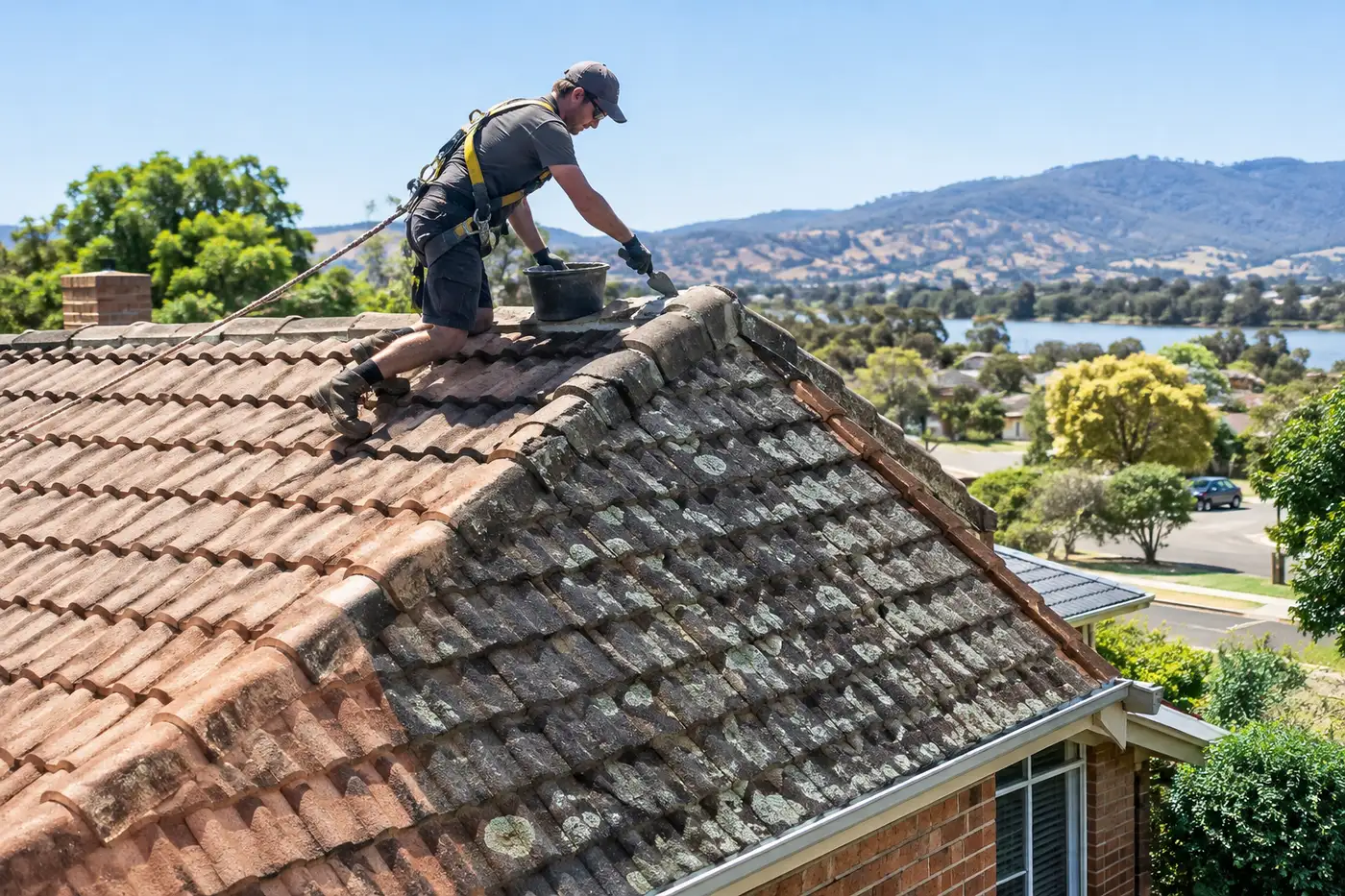
Start with the ridge. The ridge caps are the curved tiles along the top lines of the roof, and they sit on a bed of mortar finished with a layer called pointing. Repointing means replacing that outer layer. Rebedding means lifting the caps and laying them on fresh mortar first. If the bedding underneath has broken down, repointing alone is putting a new skin on a crumbling base. It looks fine on handover day and fails early.
Albury and Wodonga's hot summers and cold, wetter winters keep the roof expanding and contracting all year, and that movement works old mortar loose. That's why we use flexible pointing compound as standard: it handles the movement better than rigid sand and cement.
Then there are the tiles themselves. Cracked, broken or slipped tiles have to be replaced before any coating goes on, otherwise the coating just seals the problem in. A good quote either counts the tiles that need replacing or tells you how replacements will be handled if more turn up during cleaning. If your roof only needs a few tiles sorted and nothing else, a standalone cracked tile replacement and leak repair may be all you need right now.
Valleys are the last big variable. These are the metal channels where two roof slopes meet and water runs off. A corroded or cracked valley can't be fixed with a coat of paint, and replacing one means lifting and reinstating tiles along its length.
What a full restoration should actually include
If you're comparing quotes, this is the scope a proper tile roof restoration should cover. Missing items are not always wrong, but you should know they're missing.
- An on-site inspection, with photos of what was found
- High pressure cleaning to strip moss, lichen and grime
- Broken or slipped tiles replaced
- Ridge caps rebedded where needed, then repointed
- Primer to seal the tile surface
- Topcoats applied to the coating maker's specification
- A final walk-through and written warranty
That is exactly the order we follow on our roof restoration work across Albury and Wodonga, and most homes take one to three days on site. Bigger or steeper roofs, or a lot of ridge work, can stretch that out.
Sometimes painting alone is the cheaper, honest answer
Not every tired-looking roof needs a full restoration. If the pointing is sound, the tiles are intact and there's no water getting in, the problem may only be a faded, weathered surface. In that case a clean and recoat does the job, and it costs less because there's no structural work in it.
The reverse is also true. If the ridge pointing is cracked, tiles are broken, or there's a leak, painting over it is money spent on looks alone. We explain the difference in more detail on our roof painting and recoating page. The inspection is what decides which one you need, and we'll tell you if the smaller job is the right one.
What we see across Albury and Wodonga
The housing mix here shapes what restoration jobs involve. Established tile roof areas such as Lavington and North Albury have plenty of older concrete tile roofs, and on those the ridge work is often the biggest part of the quote after decades of seasonal movement. In the newer growth areas around Thurgoona and the Baranduda and Leneva corridor, you're more likely to find contemporary metal roofs, though plenty of tiled homes are mixed in. A metal restoration is a different scope altogether.
Further out, older homes in Beechworth and Yackandandah need a property-by-property look. Roof condition, materials and any heritage controls all need checking before anyone can quote properly.
Weather affects timing more than price. Coating can't go on in rain or below the temperature the coating maker specifies, and on hot summer days we work the cooler part of the day. Winter narrows the window, so a winter booking may simply take longer to schedule.
How to compare two quotes fairly
When a homeowner shows us two quotes that are miles apart, we usually check the same few things.
First, is the scope written down item by item? "Restore roof" on one line tells you nothing. You want to see cleaning, the ridge work (rebedding, repointing or both), tile replacement, primer, and how many topcoats.
Second, does the quote say what happens if more damage turns up during cleaning? Cleaning often reveals cracks that were hidden under lichen. A fair quote explains how that's handled before work starts, not after.
Third, what is the warranty, and is it in writing? Ours is a 15-year double-backed warranty, which covers both the materials and the workmanship. Whoever you choose, get the warranty length and what it covers on paper.
Last, did anyone actually get on the roof? A quote done from the driveway, or from a satellite photo, can't see the state of the bedding under the ridge caps. That's often the most expensive line on the job.
Restoration against a new roof is a different sum
For a roof with a sound structure underneath, restoration costs a fraction of a replacement and can add 15 to 20 years of service life. That's why it's the usual choice for established homes here.
It stops being good value when the problems go deeper than the surface: rafters, sarking (the membrane under the tiles) or the tile bed in poor shape. At that point, spending on a coating is spending on the wrong thing, and we'll say so.
Timing with solar is worth a thought too. If panels are planned, doing the roof first means nobody has to work around them later.
Get a number that's actually for your roof
The only price worth budgeting around is one written after someone has inspected your roof. We'll get up there, photograph what we find, and give you a fixed written quote with the scope spelled out line by line. You can read more about how we restore tile and metal roofs, or call us on (02) 6084 7048, Monday to Friday 8:00am to 5:00pm and Saturday 8:00am to 12:00pm.