
Here is a call we get more often than you would think. A homeowner has two quotes to paint their tile roof. One says the tiles need a primer and two topcoats. The other says the tiles are fine and only the ridges need work. Same roof, two very different answers.
More often than not, the gap comes back to a question nobody wrote down: are the tiles terracotta or concrete? Terracotta vs concrete roof tiles is usually framed as a choice for people building a new home. For most of the homeowners we meet around Albury and Wodonga, the tiles were chosen decades ago. What matters now is knowing which ones you have, because that decides how the roof ages, what maintenance it needs and what a fair quote should include.
Two tiles that look alike from the footpath
Terracotta tiles are made from clay that is shaped and then fired in a kiln. The colour goes right through the body of the tile, and some terracotta tiles also carry a glazed finish that gives them a slight shine.
Concrete tiles are a mix of cement and sand pressed into shape. Their colour mostly sits in a coating on the surface. When that coating wears away, you are looking at bare concrete, which is grey, rough and porous (it soaks up water a bit like a sponge).
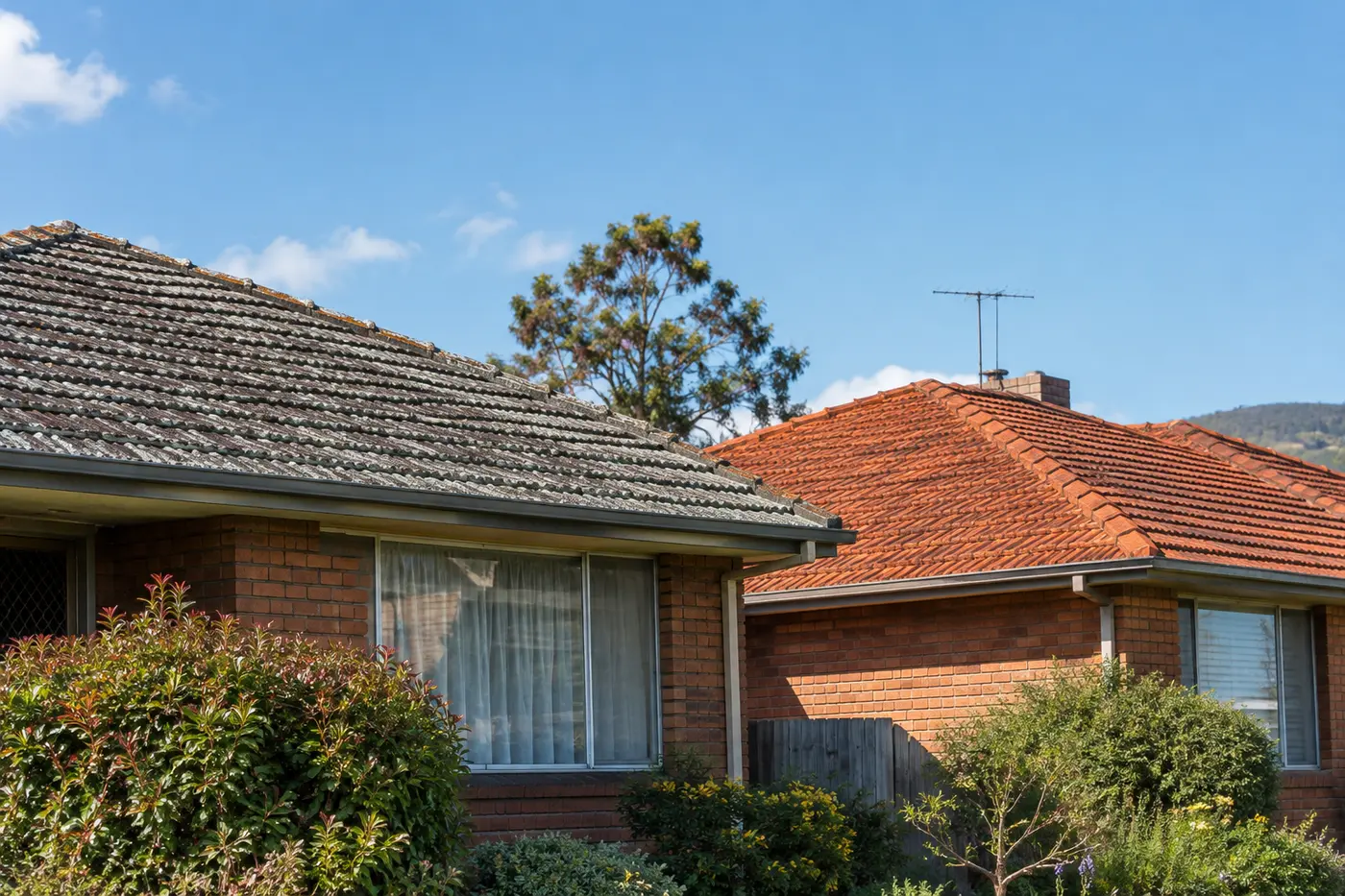
From the street, after a few years of weather, the two can look surprisingly similar. Up close they behave very differently.
| Terracotta | Concrete | |
|---|---|---|
| Made from | Fired clay | Cement and sand |
| Where the colour sits | Right through the tile | Mostly in a surface coating |
| How it shows its age | Colour fades slowly, tile stays dense | Coating wears, tile starts absorbing water |
| Painting | Needed less often, often cosmetic | Restores the water-shedding surface |
| A chipped edge shows | The same colour as the face | A grey core |
You can usually tell which you have without climbing up
Please stay off the roof for this. Tiles crack under a foot that lands in the wrong spot, and a fall from a single storey is still a serious fall. There are easier ways to find out.
Start with spares. Builders often left a stack of leftover tiles in the shed, under the house or behind the garage. Look at a broken edge: if the colour runs all the way through, it is terracotta. A grey middle under a coloured skin means concrete.
From the ground, a concrete roof with a worn coating tends to look patchy and chalky, with darker damp areas that hang around after rain. Terracotta usually holds a more even colour, even when it is old. Glazed terracotta has a sheen you can spot from the yard.
The age of the house is a hint, not proof. Plenty of the brick veneer homes built across Albury from the 1960s through to the 1980s went up with concrete tiles, but there are exceptions in every street, and some roofs have had tiles swapped over the years.
Concrete tiles wear from the surface down
This is the one that catches people out. The concrete tile itself is a solid product. The weak point is the factory coating on top, which typically starts breaking down after 10 to 15 years.
Once that coating goes, the tile takes on more water every time it rains. Moss and lichen find the damp surface easy to settle on, and the roof darkens unevenly as wet patches dry more slowly than the rest. Albury and Wodonga's hot summers and cold, wetter winters keep that cycle moving.
That is why concrete roofs make up so much of the painting work we do. A proper job here is not just about colour. Cleaning, a penetrating primer and topcoats put back the surface that stops the tile soaking up water. If you want to see how that process runs, we cover it on our concrete and terracotta tile painting page.
Preparation is where these jobs succeed or fail. Paint rolled onto a tile that has not been properly cleaned and primed can start peeling within three to five years.
Terracotta holds its colour but still needs looking after
Terracotta is denser than concrete and often does not need painting as often. When an old terracotta roof looks faded, the tile underneath is frequently still shedding water well, so a recoat can be more about appearance than protection.
When terracotta does get painted, it needs different handling. Its surface is less porous, so the primer has to be chosen carefully or the topcoat will struggle to grip. Not every coating that suits concrete is right for terracotta. If a painting quote for a terracotta roof names the same product you would use on concrete, it is fair to ask why.
Where terracotta gives trouble is usually elsewhere: cracked or chipped tiles from impact, foot traffic or falling branches, and the mortar along the ridges. Which brings us to the work that is the same on both.
Ridges, valleys and broken tiles do not care what the tiles are made of
Every tile roof has ridge caps, the curved tiles along the top lines, sitting on a bed of mortar with a finishing layer called pointing. Here the temperature swings from summer highs above 40°C to winter lows near 0°C, and that constant expansion and contraction cracks rigid mortar over time. We use flexible pointing compound on both tile types because it copes with that movement far better.
Valleys, the metal channels where two roof slopes meet, wear out on terracotta and concrete roofs alike. So do the seals around vents and skylights.
Broken tiles are the one place the material makes a practical difference. Roofs installed 20 or 30 years ago may use tiles that are no longer made in the same colour or profile, so finding a match takes some work. Where an exact match is not possible, we can often move better-matching tiles from a hidden part of the roof to the visible spot and put the replacements where nobody will notice. Our cracked and broken tile repair service explains how we handle that.
What we see on roofs across Albury and Wodonga
In the established suburbs, concrete is the common story. Lavington, North Albury, West Albury and Springdale Heights all have large numbers of brick veneer homes with concrete tile roofs, many of them well into their maintenance cycle by now. Established central Wodonga is much the same.
The growth areas look different. Thurgoona, Baranduda and Leneva have plenty of contemporary metal roofs, along with newer tile roofs that are still early in their maintenance cycle.
Older homes in Beechworth and Yackandandah need a property-by-property look. Some will have terracotta, some will not, and heritage controls may affect what you can change. If you are thinking about a new colour or replacing tiles on an older home there, check with council before anything is ordered.
A good quote names the tile and the coating system
When we help people compare quotes, the tile type is one of the first things we look for. A painting or restoration quote should say what the tiles are made of and which primer and topcoat will go on them. If it says neither, the person quoting may not have looked closely.
The rest of the comparison is about scope: cleaning, ridge work, broken tile replacement and the number of coats. We walk through that line by line in our guide to what drives restoration quotes in Albury Wodonga.
Not sure which tiles you have? We will tell you on site
If you cannot find a spare tile and the roof is hard to read from the ground, that is fine. Confirming the tile material is part of every inspection we do, and it shapes which coating system we recommend. Our work carries a 15-year double-backed warranty covering materials and workmanship. Have a look at how we approach painting tile roofs in Albury and Wodonga, or call us on (02) 6084 7048 to book an inspection.