
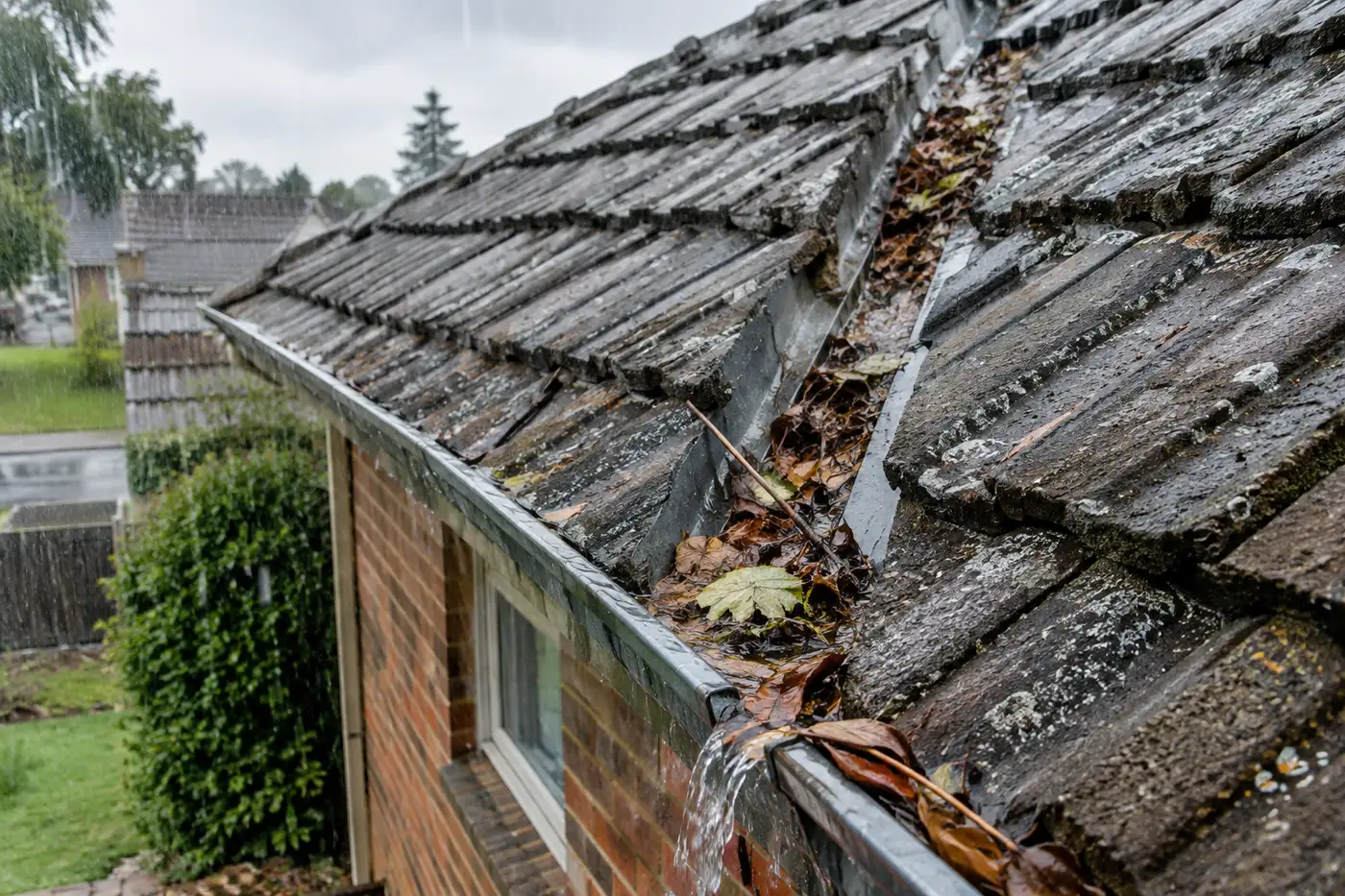
It has drizzled on and off all week and the ceiling has stayed dry. Then a proper storm rolls across Albury on a Sunday afternoon, and by evening there's a brown ring spreading across the bedroom ceiling. By Tuesday the rain has gone, the stain has faded a shade, and you start to wonder if it was really a leak at all.
It was. A tile roof leaking in heavy rain but staying dry in light rain is one of the most common calls we get, and one of the most confusing for homeowners. The roof has a weak spot. It just isn't one that ordinary weather finds, and there are only a handful of places on a tile roof where these leaks usually start.
Light rain and a downpour test different parts of the roof
A tile roof isn't a sealed lid. The tiles overlap and interlock so water runs down and off them. Under most roofs there's also a layer of sarking: a foil or membrane laid over the rafters that catches the odd drip that gets past the tiles and steers it down to the gutter. Some older roofs were built without it, which leaves even less margin.
In light rain, that system copes with a lot. Small cracks, tired mortar and slightly lifted tiles let in so little water that the sarking handles it, or it dries before it gets anywhere.
Heavy rain changes three things at once. Far more water runs down every tile. The valleys and gutters have to carry all of it at the same moment. And in a storm, wind drives rain sideways and even uphill, into gaps that gravity alone would never fill. Any one of those can turn a small fault into a drip on your ceiling.
Valleys are the first place we check
A valley is the channel where two roof slopes meet, usually lined with metal. It collects the runoff from both slopes, so on a roof with several valleys those channels carry a surprising amount of water in a storm.
When a valley is partly blocked with leaves, has rusted through, or is so narrow that the tiles either side almost meet over the channel, it can't move the water away fast enough. Water banks up and spills sideways under the tiles. In a light shower the same valley drains fine, which is why the problem can hide for years.
Homes under big trees tend to collect more debris in the valleys. Some older Albury and Wodonga homes also still have lead valleys, which can split or lift with age. If a valley has corroded or split, clearing it out won't stop the leak, and we explain what's involved in replacing a worn roof valley and relaying the tiles around it.
Cracked ridge mortar lets in wind-driven rain
The ridge caps are the curved tiles along the top lines of the roof. They sit on a bed of mortar, sealed along the edges with a finish layer called pointing.
Our hot summers and cold, wetter winters keep that mortar expanding and contracting all year, and eventually the pointing cracks. In gentle rain, water runs straight past those cracks. In a storm, wind pushes it in. From there it soaks into the mortar bed and drops into the roof space near the top of the house.
The fix is either repointing (replacing that outer layer) or rebedding (lifting the caps and laying them on fresh mortar) when the bed underneath has broken down. We use flexible pointing compound because it handles the region's temperature swings better than rigid sand and cement, and our repointing work carries a 15-year double-backed warranty on materials and workmanship.
A cracked tile can stay dry for years, until it doesn't
Hairline cracks, a tile that has slipped a few centimetres, a broken corner hidden under lichen. These are easy to miss from the ground and often let in nothing during normal weather, because the sarking catches what little gets through.
A heavy, wind-driven storm overwhelms that. Water comes through the gap faster than the sarking can carry it away, or finds a tear in old sarking, and ends up in the ceiling.
How tiles crack and wear depends partly on what they're made of. If you're not sure what's on your roof, our guide to how terracotta and concrete tiles age shows you how to tell them apart and what each tends to do over time.
One detail we always look at: a tile cracked at its top end often points to a problem with the batten underneath, not the tile itself. Swap the tile without checking why it cracked and the new one can break the same way.
Flashings and gutters fail under volume
Anywhere something pokes through the roof (a vent pipe, an antenna, a skylight, a flue) there's a flashing or seal around it. Old sealant shrinks and cracks, and the gap is usually small enough that only heavy rain finds it.
Gutters are the other one. When a gutter overflows in a downpour, water can back up under the bottom row of tiles or spill over the inside edge into the eaves. That kind of leak usually shows up near an outside wall rather than in the middle of a room.
The stain is almost never under the hole
This one surprises most people. Water that gets under the tiles rarely drops straight down. It runs along the sarking or a rafter, sometimes a fair distance, until it hits a low point or a gap and drips onto the ceiling. A stain in the hallway can start at a valley above the lounge room.
That's why patching the roof directly above the stain so often fails, and why a proper leak investigation traces the water path from where it gets in to where it comes out. We check the roof surface and, where needed, the underside of the roof from the ceiling space.
Leaks that only appear in heavy rain can be harder to pin down. Sometimes the clearest evidence is only there during or just after a storm, and we'll tell you honestly if that's the case with yours.
What to do while it's raining, and what to leave alone
If water is coming through right now, the goal is simply to limit the damage until the weather clears.
- A bucket under the drip, with furniture, rugs and electronics moved out of the way
- Power to that circuit switched off at the switchboard if water is near a light fitting or power point
- Everyone kept out of the room if the ceiling is sagging or bulging, as wet plasterboard can give way
- Photos, plus a note of the time, how heavy the rain was and which way the wind was blowing
Please don't climb onto the roof. Wet tiles are slippery, cracked tiles break underfoot, and a storm is the worst possible time to be up there. Your notes on timing and wind direction will help us far more than anything you could see from a ladder in the rain.
A leak that only shows up in storms still needs fixing
Because the ceiling dries out between storms, it's tempting to leave it. But every heavy rain wets the same timber, insulation and plasterboard again, and Albury and Wodonga's colder, wetter months bring more chances for that to happen.
In our experience, these leaks usually come back to one localised fault: a single valley, a run of ridge pointing, a few cracked tiles or a failed seal. Found properly, they're contained jobs. Our tile roof leak investigation and repair work starts with finding the cause, and we do standalone repairs without pushing a full restoration. If the inspection shows the wider roof is near the end of its life, we'll say so and explain your options.
Get the leak traced before the next big storm
If your ceiling has marked up after heavy rain, jot down when it happened and call us on (02) 6084 7048, Monday to Friday 8:00am to 5:00pm and Saturday 8:00am to 12:00pm. We'll inspect the roof, show you photos of what we find and give you a fixed written quote. You can also read more about how we fix cracked tiles and stop tile roof leaks across Albury and Wodonga.