
There's a brown patch on the ceiling, so you ring around. One roofer gives you a figure over the phone without asking much. Another says they won't put a price on it until they've been up on the roof. You're left wondering which one is being straight with you.
Usually it's the second one. Roof leak repair cost in Albury and Wodonga varies more than almost any other roofing job, because the price depends on what's causing the leak, and nobody knows that until they find it. Some roof leak repairs are a single tile and an hour on the roof. Others turn out to be a rusted valley or a whole ridge line that has let go. Here's what actually moves the number, so you can tell a fair quote from a guess.
Nobody can price a leak they haven't found
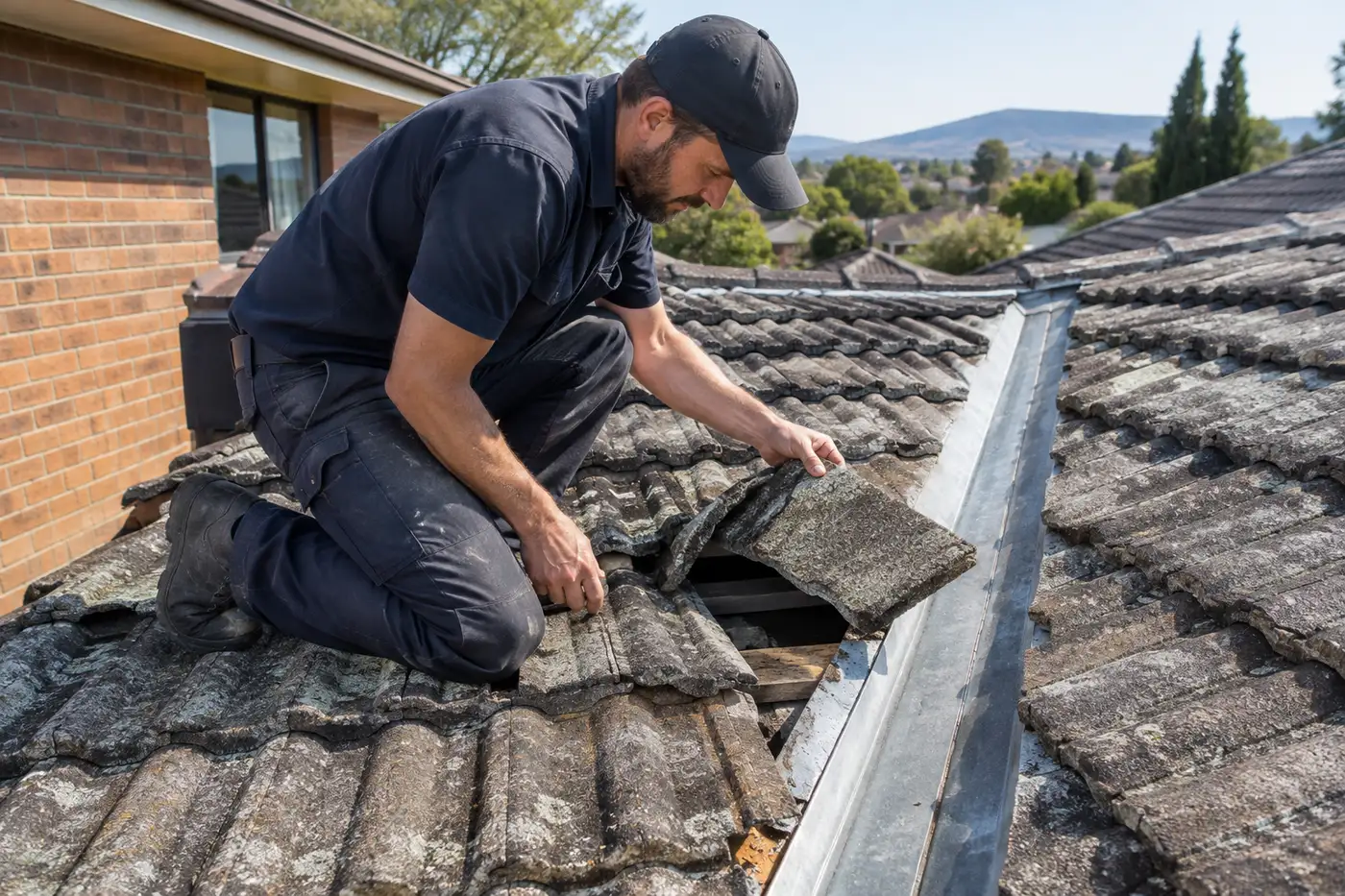
The stain on your ceiling tells you where the water came out, not where it got in. Water that gets past the tiles tends to run along the sarking (the foil or membrane under the tiles) or down a rafter before it drips. We regularly trace a stain in one room back to a fault several metres away.
That's why a phone price for a leak is really a price for a visit, plus whatever gets found. The finding is the skilled part of the job. Once the cause is clear, the repair itself is often the easy bit.
Leaks that only show up in a downpour are the trickiest to pin down, and they sometimes need a second look. If that sounds like yours, our guide to why tile roofs leak only in heavy rain walks through the usual suspects.
Most leaks fall into three sizes of job
We don't publish prices, because two leaks that look the same from inside can be very different jobs on the roof. What we can do is explain the rough bands most leak repairs fall into, from smallest to largest.
- Small, contained fixes. A cracked or slipped tile, a lifted tile after wind, or a perished seal around a vent pipe or antenna. Often done at the same visit as the inspection if we have a matching tile.
- Middle-sized repairs. A run of cracked ridge pointing that needs redoing, ridge caps that need lifting and rebedding on fresh mortar, or several damaged tiles across one section.
- Larger repairs. A corroded or split valley that needs replacing, with the tiles either side taken up and relaid. On metal roofs, rust that has gone through at the laps or flashings.
Most of the leaks we're called to across Albury and Wodonga come back to one localised fault. That's good news. It means most leak repairs are contained jobs, not the start of a whole new roof.
Five things that push the price up or down
Getting onto the roof safely
A single-storey home with a gentle pitch is quick to access. A steep roof, a second storey, or a section above a sloping block needs more safety gear and more time, and that shows in the quote whatever the fault is.
Whether your tiles can still be matched
Replacing a cracked tile is simple when the profile is common. Older or discontinued tiles can be hard to find, and sometimes we have to source a match before coming back. That adds a return visit.
How long the leak has been running
This one surprises people. A leak caught after the first storm is usually just the fault itself. One that has been dripping for a couple of winters may have wet the battens, rotted timber or broken down the mortar around it, so the repair grows to cover the damage the water caused along the way.
What's going on underneath
A tile cracked at its top end often points to a batten problem underneath. Swapping the tile without fixing the batten just means another cracked tile later. Torn or missing sarking on an older roof can have the same effect, letting a small gap cause a bigger leak than it should.
Damage inside the house
Stained or sagging plasterboard, wet insulation and damaged paint are separate costs on top of the roof repair. They're also the part of the bill that keeps growing the longer a leak is left.
The cheapest fix can end up costing the most
We often get called to leaks that have been "fixed" before. Usually there's a bead of silicone smeared over a crack, or a patch put straight above the ceiling stain. It might hold through a dry spell. Then the next big storm finds the real gap and the ceiling marks up again.
Materials matter too. Ridge pointing done with rigid sand and cement struggles with our hot summers and cold, wetter winters, because the mortar keeps expanding and contracting until it cracks. We use flexible pointing compound for that reason. It handles the region's temperature swings far better.
Paying for one proper repair is nearly always cheaper than paying for three quick ones. When you compare quotes, ask each roofer what they think is causing the leak. If they can't say, they're quoting on a guess.
When a repair stops being the sensible answer
We do standalone leak repairs, and we won't refuse to fix a few tiles just to sell a bigger job. Most of the time, a targeted repair is exactly what the roof needs.
Sometimes, though, the inspection shows the leak is one symptom of a roof that is worn all over: pointing failing along every ridge, tiles cracking in several places, valleys rusting together. Fixing faults one by one on a roof like that means paying for a callout every time a new one gives way. In that case we'll show you the photos and lay out both options. If you're weighing that up, our article on what drives roof restoration pricing explains how the bigger job is priced.
For a typical tile roof leak, though, the job is finding the fault, fixing it properly and checking nothing nearby is about to follow. That's the core of our tile roof leak investigation and repairs, which starts with an on-site inspection rather than a phone estimate.
If you're claiming on insurance, get the paperwork right
Whether your insurer pays depends on your policy and on what caused the leak. Insurers often look at whether the damage came from a sudden event like a storm or from gradual wear, so that's a conversation to have with them early.
What we can do is give you a written assessment and a scope of works for your claim, with photos of what we found. We don't inflate repair quotes for insurance and we don't add work the roof doesn't need. Take your own photos of the ceiling and note the date and weather when the leak first appeared. Insurers tend to ask for exactly that.
What a fair leak repair quote should tell you
A quote worth trusting answers a few plain questions. What's causing the leak, and where is it? What exactly will be repaired or replaced? Is there anything else nearby that's close to failing, and is that included or listed separately? And what happens if the leak comes back?
Photos make a big difference here. Most homeowners never see their own roof up close, so a quote backed by pictures of the cracked tile or the rusted valley lets you check the scope makes sense. Every job we do comes with a fixed written quote, and our work carries a 15-year double-backed warranty covering both materials and workmanship.
Find out what your leak will really cost
The only accurate price for a roof leak is one based on the cause. Call us on (02) 6084 7048, Monday to Friday 8:00am to 5:00pm or Saturday 8:00am to 12:00pm, and we'll come out for a free inspection, trace the leak to its source and give you a fixed written quote with photos. You can also see how we find and fix tile roof leaks across Albury and Wodonga before you book.